
“He’s a bridge figure,” says Dr. Frank-Jürgen Richter Chairman, Horasis: The Global Visions Community. “He can toggle between hard power and soft power in the same sentence-and make both sides feel heard.”
Power Without Noise
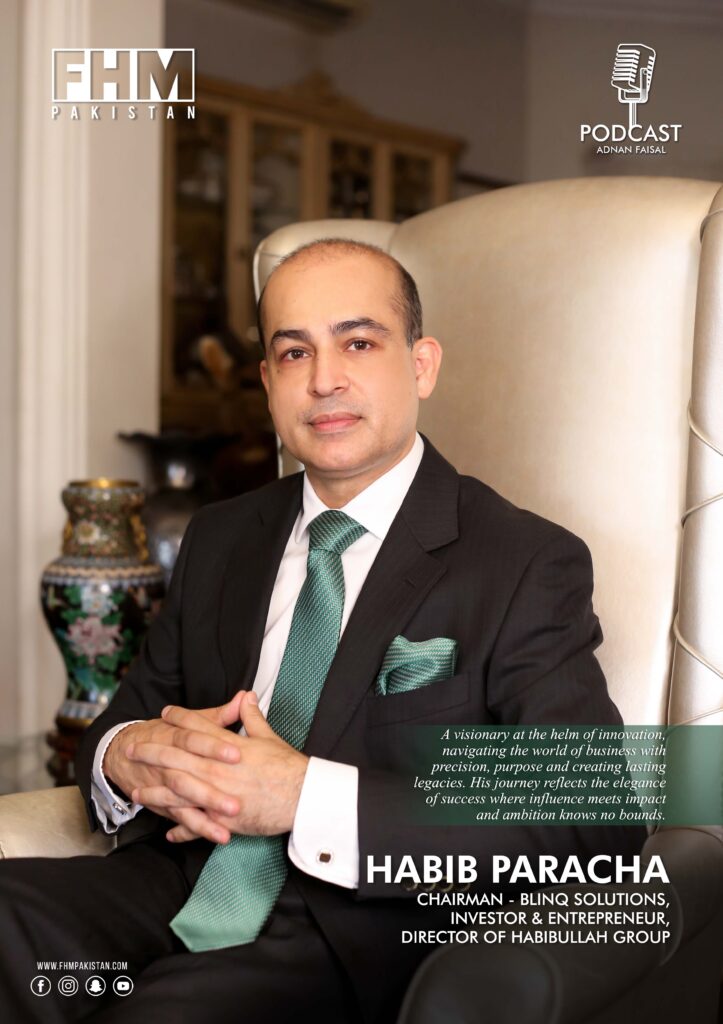
In an age saturated by noise where headlines scream, tweets ricochet, and visibility is mistaken for influence Habib Paracha operates in quieter frequencies. His presence is not broadcast; it is inferred. Yet from Washington to Istanbul, Hong Kong to Los Angeles, his fingerprints are increasingly visible on the levers of power and policy, commerce and culture.
The Pakistani-born strategist is neither household name nor headline fixture. Yet he commands a degree of access and trust rarely accorded to those outside formal office. Former diplomats, venture capitalists, and policymakers alike describe Paracha as a man who connects not just people, but systems often without stepping into the spotlight himself.
From Karachi to the World
Paracha’s journey is difficult to categorise. Eschewing the familiar paths of political legacy or corporate ascent, he has assembled a career that is less résumé than constellation. With early ventures in finance and media, and subsequent roles in advisory capacities across sectors, Paracha has come to occupy a rarefied middle ground between influence and execution.
His professional ethos is grounded in bridge-building. For global investors, he offers clarity and counsel on Pakistan’s byzantine political and economic landscape. For domestic entrepreneurs, he opens doors abroad. For multinationals, he serves as both guide and translator across regulatory and cultural fault lines.
Above all, he excels in navigating political ambiguity. Trusted in both Islamabad and Washington, Paracha remains one of the few figures who can fluidly converse with a U.S. senator and a Pakistani cabinet minister in the same afternoon and leave both feeling heard.
Diplomacy Without Portfolio
Though rarely bound to official title, Paracha has long operated as a backchannel offering quiet counsel where diplomacy and complexity converge. He has lent his insight to matters ranging from economic reform and counter-extremism to education and emerging technology.
In this, he is part emissary, part strategist. He is equally at ease at Davos or the UN General Assembly as he is in more discreet bilateral settings. On any given day, he may move from a policy dialogue with an IMF official to a conversation with a Gulf sovereign wealth fund, then on to a cultural briefing with a film producer.
Industry, Narrative, and Innovation
Though known to some as an executive producer of critically acclaimed films, Paracha views the creative industries less as entertainment and more as diplomacy by other means. For him, storytelling is a vector for identity, reform, and empathy.
His production work has illuminated narratives around climate resilience and migration, including a short film showcased at the UN Global Innovation Hub during COP28 in Dubai. Such efforts reflect a larger project: to widen the aperture through which Pakistan and other emerging markets are viewed.
Simultaneously, Paracha’s role in venture capital and emerging technology has made him a sought-after advisor for firms navigating frontier markets. From Doha to Miami, he helps construct platforms that aim not merely to scale businesses but to reimagine how capital, talent, and trust intersect.
The Philosopher-Strategist
Those closest to Paracha describe a reflective interlocutor, at once attuned to macroeconomic currents and ancient poetry. He quotes Rumi with the same fluency he discusses digital infrastructure, and contemplates questions of governance, ethics, and identity with the patience of a scholar.
His conversations often circle back to values. What, he asks, should influence do? How can power serve as stewardship rather than dominion? What does it mean to build systems that are both scalable and humane?
His commitment to education is more than rhetorical. He mentors young leaders, advises academic institutions, and promotes initiatives aimed at adapting curricula to a post-industrial, multipolar world.
The Architecture of Quiet Power
In an era where influence is often monetised, branded, or broadcast, Habib Paracha represents a subtler model—relational rather than transactional, connective rather than declarative.
He is not a statesman, yet he shapes policy. Not a financier, yet he allocates capital. Not an academic, yet he reframes pedagogy. Not a diplomat, yet he advances dialogue across continents.
His legacy remains in motion, as does he. But in a world recalibrating its notions of power, Paracha’s trajectory offers a quiet thesis: that the future will belong not to the loudest voice in the room, but to those capable of listening deeply, strategically, and across borders.
